
Productscpzx

1. Product Introduction
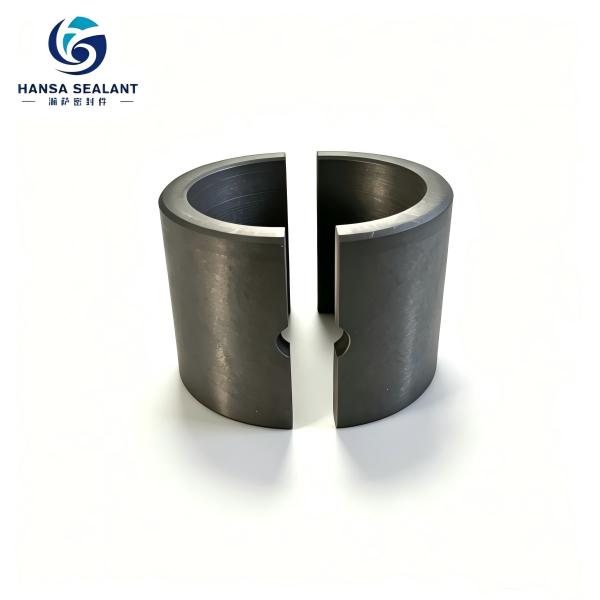
This component is a 60% bronze‑filled PTFE split open‑type bearing bushing. It takes virgin polytetrafluoroethylene (PTFE) as the base material, with bronze powder incorporated as filler at a weight fraction of 60% for property modification.
Manufacturing Process: PTFE resin is thoroughly blended with bronze powder. The compound is compression ‑moulded to produce green blanks. Subsequent high‑temperature sintering cures the blanks into solid bronze‑PTFE tubular stock. Finished bushings with split gaps and positioning notches are manufactured via precision turning, grooving and slitting operations. Thanks to its split structure, the bushing can contract to clamp the shaft for tool‑free assembly, and it serves widely as an oil‑free sliding bearing.
2. Physical and Chemical Properties
| Item | Specification & Description |
| Coefficient of Friction | 0.12‑0.18. Slightly higher friction coefficient than virgin PTFE, yet drastically improved wear resistance for continuous running conditions. |
| Operating Temperature Range | -200℃ to +260℃; peak transient temperature up to 280℃. |
| Compressive Performance | Bronze filler delivers superior creep resistance and mitigates cold flow of PTFE, enabling the bushing to withstand substantial radial loads. |
| Thermal Conductivity | Far higher thermal conductivity compared with unfilled PTFE. Frictional heat dissipates rapidly to prevent over‑heating and surface melting. |
| Chemical Resistance | Retains the core corrosion resistance of PTFE. Bronze content is vulnerable to strong oxidizing acids and ammonia. Not suitable for media containing ammonia or concentrated nitric acid. |
| Self‑lubricating Feature | Intrinsic self‑lubrication eliminates continuous oil supply, permitting dry‑run oil‑free service. |
| Coefficient of Linear Expansion | Markedly reduced versus pure PTFE for enhanced dimensional stability under temperature fluctuations. |
| Hardness | Shore‑D 60‑68, harder than unfilled PTFE. |
3. Typical Application Fields
| Industry | Component Application |
| Hydraulic Equipment | Bushings for hydraulic valves, cylinder guide sleeves, pump sliding bearings |
| General‑Purpose Construction Machinery | Oil‑free bearings for travelling assemblies, pivot split liners at hinged joints |
| Compressor Industry | Sliding support sleeves for oil‑free compressors |
| Metallurgical Equipment | Guide bearings for conveyor rollers, high‑temperature sparsely‑lubricated pivot points |
| Marinery Machinery | Drive‑shaft support liners for non‑corrosive marine environments |
| Automation Equipment | Sliding support components for heavy‑duty conveyor lines |
4. Selection & Design Guidelines
Note: Custom inner diameters, outer diameters and heights are supported for bronze‑filled split PTFE bushings. The table below lists standard reference dimensions.
Design Tip: The split clearance contracts upon assembly. Housing bore dimensions must closely match the outer diameter via interference fit to close the opening appropriately. Recommended unilateral clearance between shaft and bushing ranges from 0.07~0.15 mm.
| No. | Inner Diameter(mm) | Outer Diameter(mm) | Height(mm) | Remarks |
| 1 | 30 | 40 | 30 | Standard split, with positioning notches |
| 2 | 40 | 50 | 40 | Heavy‑load hydraulic guide sleeve |
| 3 | 50 | 62 | 50 | Pivot bushing for metallurgical conveyors |
| 4 | 60 | 72 | 60 | Support bushing for pump assemblies |
Key Design Points
(1).Permissible linear velocity ≤2.5 m/s; limiting PV value stands at approximately 1.8 MPa·m/s. Wear and thermal failure accelerate once the PV threshold is exceeded.
(2).Shaft surface roughness of Ra0.8 or finer is recommended; hardened steel is preferred for shaft material.
(3).Media Restriction: Avoid ammonia and concentrated oxidizing nitric acid; compatible with most alkaline media.
(4).Positioning Notches: Notches serve assembly alignment and shall not sustain heavy shear impact.
Customisation: Inner‑outer diameters, heights, split‑gap width and notch geometry can be modified per drawings.
5. Operation and Maintenance
(1).Assembly: Apply uniform pressure to press the bushing into the housing. Percussive hammering at discrete spots is forbidden to prevent cracking. The split gap shall narrow moderately after fitting and must not jam completely shut.
(2).Run‑in Procedure: Conduct low‑speed no‑load running‑in for 30‑60 minutes prior to full‑load commissioning, allowing a stable lubricating transfer film to form across friction surfaces.
(3).Auxiliary Lubrication: Dry‑run operation is standard. Lithium‑based grease may be sparingly applied for extended service life under intermittent operation as supplementary lubrication only.
(4).Periodic Inspection: Monitor wall‑thickness wear periodically. Replace the bushing once unilateral wear surpasses 0.3 mm; watch for abnormal temperature spikes.
(5).Forbidden Operating Conditions: Abrasive particulate debris must not penetrate the friction clearance. Dust‑proof sealing structures are mandatory for dusty service environments.
6. Development Trends
(1).Formulation Refinement: Trace additions of graphite or molybdenum disulphide compounded into the 60%‑bronze grade lower friction coefficients and expand allowable PV boundaries.
(2).Precision Machining Upgrades: CNC turning with dedicated tooling tightens dimensional tolerances for split gaps and notches, minimising part‑to‑part deviation for automated high‑volume assembly.
(3).Structural Diversification: Product portfolio expands beyond straight split sleeves to flange‑type bronze‑filled PTFE sliding bearings.
(4).Sustainable Manufacturing: Closed dust‑recovery systems for powder‑blending cut raw‑material losses, complying with EU REACH export requirements.
7. Market Expansion Opportunities
(1).Hydraulic Retrofit Segment: Direct substitution for solid bronze bushings cuts component weight and eliminates continuous lubrication to reduce overall maintenance expenditure.
(2).Overseas Construction Machinery Spare‑parts Market: Strong aftermarket demand prevails across Europe, America, Southeast Asia. Split‑style liners simplify disassembly, which suits equipment‑repair spare‑part markets well.
(3).Application Boundary Reminder: The 60% bronze‑filled grade is unsuitable for heavily corrosive chemical service. Switch to glass‑fibre or carbon‑filled PTFE variants for such aggressive media.
(4).Business Direction: Offer drawing‑based custom‑manufacturing for original‑equipment manufacturers. Optimise wall thickness and bronze loading in accordance with application‑specific PV parameters.
8. Summary and Closing Remarks
60% bronze‑filled split PTFE bushings remedy prominent drawbacks of virgin PTFE, namely severe cold‑flow creep and poor thermal conductivity. They combine PTFE’s self‑lubricity and corrosion resistance with bronze‑derived wear resistance, high thermal conductivity and creep resistance. The split construction streamlines assembly, establishing it as a proven oil‑free sliding‑support solution for hydraulic units and construction machinery.


