
Productscpzx

1. Product Introduction
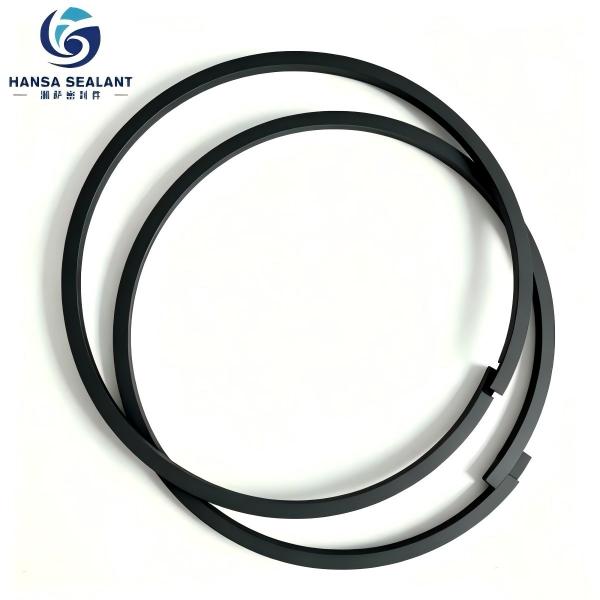
25% carbon-graphite filled PTFE machined parts are high-polymer wear-resistant structural components manufactured from virgin PTFE matrix uniformly blended with 25% carbon and graphite composite fillers. Produced through mould pressing, sintering and high-precision CNC turning, the mainstream product forms include split guide rings, piston rings and support rings with standard oblique split circular structures.
Modified by carbon-graphite fillers, these products effectively overcome the inherent defects of pure PTFE such as poor wear resistance and cold flow creep, while retaining PTFE’s superior properties of chemical resistance, wide temperature adaptability and ultra-low friction. Mainly applied for piston guiding, bearing support and anti-friction protection in reciprocating and rotating working conditions, these parts serve as auxiliary wear-resistant components rather than primary sealing elements, preventing direct metal-to-metal abrasion inside equipment.
2. Core Performance Features
Self-lubricating & Low Friction: The graphite component provides stable solid self-lubrication, enabling reliable operation under dry and oil-free friction conditions. The friction coefficient is significantly lower than ordinary unmodified engineering plastics, suitable for intermittent and non-lubricated working scenarios.
Excellent Wear Resistance & Anti-Creep Performance: The precisely proportioned 25% carbon-graphite filler greatly restrains the cold flow (creep) phenomenon of PTFE materials, effectively improving compression resistance and service life, and avoiding permanent deformation failure under high pressure.
Broad Chemical Compatibility: Inheriting the excellent medium resistance of PTFE base material, the product resists most industrial hydraulic oils, synthetic lubricants, weak acids, weak alkalis and aqueous solutions, adapting to complex chemical and mechanical environments.
Ultra-Wide Operating Temperature Range: Continuously stable from -200℃ to +260℃ with no obvious attenuation in dimensional stability, friction performance and mechanical properties under extreme high and low temperature conditions.
Split Compensation Structure: Adopting standard 45° oblique split design, the ring allows slight radial expansion and contraction after installation, automatically compensating assembly and operating clearances between cylinder and piston to improve equipment stability.
Superior Dimensional Stability: Compared with pure PTFE products, the compression set performance is greatly optimized, resisting extrusion deformation and bulging under high pressure and high-frequency reciprocating operation.
Working Condition Limitations: Carbon-graphite fillers make the material weakly conductive and unsuitable for insulating scenarios. It cannot resist strong oxidizing media and molten alkali metals. Limited by moderate hardness, it is prohibited for working conditions with hard abrasive particles.
3.Material & Specification System
3.1 Material Proportion
Standard formula: 75% virgin PTFE + 25% carbon-graphite composite filler. Carbon powder improves material hardness, structural strength and compression resistance, while graphite enhances self-lubrication and reduces friction coefficient. Among common industrial ratios (15%, 25%, 40% carbon-graphite filling), 25% filling grade is the standard preferred material for hydraulic cylinders and general mechanical wear-resistant parts.
3.2 Common Product Forms
Mainstream styles: split guide rings, piston support rings, oblique-cut wear rings dedicated to hydraulic cylinders. Non-standard styles: solid integral rings, wear gaskets, sliding blocks, shaft sleeves and various custom precision turned special-shaped parts.
3.3 Standard Specification System
Dimensional parameters: Inner Diameter (ID) matching piston outer diameter, Outer Diameter (OD) matching cylinder bore, section width and height, supporting metric and imperial customization. Split types: 45° standard oblique cut, straight cut and step cut. Machining tolerance: ±0.05~±0.15mm for standard CNC finishing, with ultra-precise tolerance customization available. Surface condition: original matte black finish without spraying or secondary coating to ensure intact material performance.
4. Technical Parameters & Performance Indicators
| Item | Performance Index |
| Filler Content | 25% Carbon-Graphite Composite Filler, 75% PTFE Base |
| Density | 2.10‑2.25 g/cm3 |
| Continuous Operating Temperature | -200℃ to +260℃ |
| Dry Friction Coefficient | 0.08‑0.18 |
| Compression Set (24h, 23℃) | <8% |
| Shore D Hardness | 55‑65 |
| Tensile Strength | ≥14 MPa |
| Elongation at Break | 120‑180% |
| Max Working Pressure | ≤40MPa (for guiding & supporting service) |
| Medium Compatibility | Mineral hydraulic oil, synthetic oil, water-glycol, weak acid & weak alkali; incompatible with molten alkali metals, strong fluorinated media and strong oxidants |
| Electrical Property | Weakly conductive, surface resistance 10⁴‑10⁶Ω |
Note: All data are based on standard laboratory test samples. Actual product performance may vary slightly due to processing technology, operating pressure, running speed and service media.
5. Typical Application Fields
Hydraulic & Pneumatic Industry: Piston guide rings and rod support rings for hydraulic cylinders of construction machinery, injection molding machines and metallurgical equipment, preventing direct metal friction between piston and cylinder barrel.
Reciprocating Compression Equipment: Piston support and guide rings for reciprocating compressors and air compressors, adapting to high-frequency reciprocating operation under oil-free or low-lubrication conditions.
Petrochemical Equipment: Wear-resistant sliding rings for reciprocating pumps, industrial valves and chemical fluid equipment, suitable for continuous operation in corrosive environments.
General Mechanical Equipment: Rotating shaft wear-resistant bushings, sliding gaskets and oil-free lubrication sliding components for intermittent operating machinery.
Heavy Metallurgical Equipment: Wear-resistant supporting parts for high-temperature hydraulic systems and heavy-load reciprocating machinery.
Special Remark: This product serves as a guiding and supporting component instead of a primary sealing part. It must be assembled with O-rings, Gleeve rings, back-up rings and other sealing elements to form a complete sealing system.
6. Machining, Connection & Installation Guidelines
6.1 Core Processing Technology
Products are manufactured from high-quality mould-pressed sintered carbon-graphite PTFE rods and tubes, through high-precision CNC turning, standard split cutting, fine deburring, dimensional calibration and visual inspection. PTFE materials cannot be thermally welded or bonded. All products are fixed by mechanical interference fit and groove clamping for stable structure and anti-drop performance.
6.2 Standard Installation Instructions
Orientation Requirement: Install the split guide ring into the piston groove with the split gap staggered from the main force-bearing surface to avoid accelerated local wear and deformation failure.
Pre-installation Treatment: Thoroughly clean piston grooves and cylinder inner walls to remove burrs, iron scraps and impurities. A thin layer of compatible grease can be applied to assist assembly and reduce installation resistance.
Assembly Operation: Expand the split ring moderately by utilizing its elasticity during installation. Forcible prying and extrusion are prohibited to prevent cracking, notching and plastic deformation.
Groove Matching: Design groove width and depth strictly according to product section dimensions with reasonable assembly clearance. Too small clearance causes extrusion bulging and jamming; excessive clearance leads to component shifting and abnormal wear.
Surface Matching Requirement: The inner wall roughness of the cylinder barrel is recommended to be Ra 0.2‑0.8μm. Rough metal surfaces will sharply accelerate ring abrasion and shorten service life.
7. Selection Decision Matrix
This matrix defines accurate selection standards covering application scenarios, core performance requirements, recommendation levels and key precautions for rapid and precise model selection.
| Application Scenario | Primary Performance Requirement | Recommendation Level | Key Notes |
| Medium-pressure standard hydraulic cylinders (construction machinery, injection molding machines, general cylinders, ≤40MPa) | Wear resistance, anti-creep, low friction, dimensional stability, hydraulic oil corrosion resistance | ★★★★★ | Standard industrial formula with optimal performance and cost performance. Must be matched with standard sealing parts and qualified groove dimensions to avoid abnormal clearance wear. |
| Oil-free / low-oil dry-running reciprocating equipment (air compressors, intermittent machinery) | Excellent self-lubrication, dry friction wear resistance, adaptability to non-lubricated operation | ★★★★★ | Realizes long-term dry operation relying on graphite self-lubrication. Avoid high-speed impact load to prevent local stress concentration and cracking. |
| Extreme temperature equipment (-200℃ low temperature / +260℃ high temperature constant working conditions) | Stable performance under wide temperature range, no deformation or mechanical attenuation at high/low temperature | ★★★★☆ | Applicable for most extreme temperature conditions. Not suitable for long-term service under frequent drastic temperature shock which accelerates material aging. |
| Conventional weak acid, weak alkali and oil-water chemical working conditions | Chemical corrosion resistance, wide medium compatibility, long-term operational stability | ★★★★☆ | Resists conventional corrosive media. Keep away from strong oxidants, molten alkali metals and high-purity fluorinated media to prevent rapid material failure. |
8. Industry Customized Solutions
Non-standard Size Customization: Supports custom inner diameter, outer diameter, section specifications and special-shaped structures. Precise reproduction according to drawings or samples, covering small-batch trial orders and mass production with full metric and imperial size systems.
Formula Fine-tuning: Adjustable carbon-graphite ratios of 15%, 25% and 30% to balance wear resistance, friction coefficient and structural hardness for different load levels.
Special Process Treatment: Provides sodium surface treatment and precision grinding polishing to meet bonding composite and ultra-precision assembly requirements.
Complete Assembly Supporting Service: Matched with O-rings, back-up rings and sealing gaskets to provide one-stop supporting components for hydraulic cylinder sealing and wear-resistant systems, reducing procurement and assembly costs.
Precision Tolerance Customization: Tightens dimensional tolerance and improves surface finish for high-end precision hydraulic and intelligent equipment scenarios to meet high-precision operation standards.
9. Storage & Maintenance
Storage Environment: Store in indoor, dry, ventilated and normal-temperature environment. Avoid long-term sunlight exposure, high-temperature heat sources and humid water accumulation to prevent aging and deformation.
Stacking Standard: Place ring products flat with no excessive heavy stacking. Store split rings separately to avoid forced closure and permanent deformation ensuring dimensional accuracy.
Storage Cycle: Modified PTFE materials feature extreme stability with no mandatory expiration date. To maintain optimal performance, the inventory turnover cycle is recommended within 5 years.
Equipment Maintenance & Replacement: Inspect guide rings thoroughly during equipment overhaul and disassembly. Replace components timely if obvious wear, notching, cracking, permanent deformation or elastic failure occurs to avoid cylinder wall scratching and precision loss.
Chemical Storage Taboo: Do not store together or contact long-term with strong oxidizing chemicals, strong alkalis and fluorides to prevent performance attenuation.
10. Development Trend
Multi-element Composite Filler Upgrading: Add molybdenum disulfide and nano wear-resistant fillers on the basis of 25% carbon-graphite formula to further reduce friction coefficient and improve high-speed wear resistance for advanced high-speed reciprocating and rotating equipment.
Ultra-precision Machining Iteration: Adopt micron-level tolerance control via high-precision CNC equipment to adapt to the miniaturization, high-pressure and precision development trend of hydraulic equipment.
Eco-friendly Clean Formula Optimization: Improve graphite precipitation technology to reduce dust shedding, developing low-precipitation clean products for food machinery, medical equipment and precision clean industrial scenarios.
Composite Structure Upgrading: Develop composite molding of carbon-graphite PTFE with metal substrates and high-strength engineering plastics, combining the self-lubricating & corrosion-resistant advantages of polymer materials with the high strength & impact resistance of metals to expand heavy-load application range.
Intelligent Quality Control: Implement full-process digital management of billet sintering, molding and machining to reduce batch performance fluctuation and realize standardized and stable mass production.
11. Market Application Expansion
New Energy Equipment Industry: Widely applied to wear-resistant guiding parts of energy storage hydraulic equipment and new energy construction machinery, replacing imported high-end accessories to reduce manufacturing costs.
Offshore Engineering Equipment: Adaptable to marine hydraulic cylinders and ship reciprocating equipment with excellent moisture and oil corrosion resistance, suitable for harsh offshore working conditions.
Domestic Substitution for General Equipment: Realizes localization replacement of imported carbon-graphite PTFE accessories for air compressors, compressors and hydraulic equipment, breaking overseas technical monopoly.
Overseas Market Expansion: Covers aftermarket hydraulic accessory markets in Europe, America, Southeast Asia and Russia. Supports metric & imperial full-scale customization to meet global OEM supporting and maintenance demands.
Special Low-temperature Equipment Field: Expands applications in low-temperature hydraulic systems, refrigeration equipment and aerospace precision wear-resistant parts relying on excellent low-temperature resistance performance.
12. Conclusion
25% carbon-graphite filled PTFE machined parts are mature and benchmark modified polymer wear-resistant components in the industrial field. Solving the core weaknesses of pure PTFE (creep and poor wear resistance) while retaining multi-dimensional advantages of corrosion resistance, self-lubrication and ultra-wide temperature adaptability, they serve as core guiding and supporting accessories for hydraulic reciprocating machinery, general equipment and chemical facilities.
With balanced performance, high cost-effectiveness and flexible customization capabilities, these products adapt to most industrial conventional working conditions. Scientific model selection, standardized installation and normative maintenance effectively improve equipment operation stability and extend overall service life. Benefiting from domestic manufacturing upgrading, high-end equipment iteration and global foreign trade expansion, 25% carbon-graphite PTFE parts will continue to broaden application boundaries in construction machinery, metallurgy & petrochemical, new energy and offshore engineering industries with promising market prospects.


