
Productscpzx

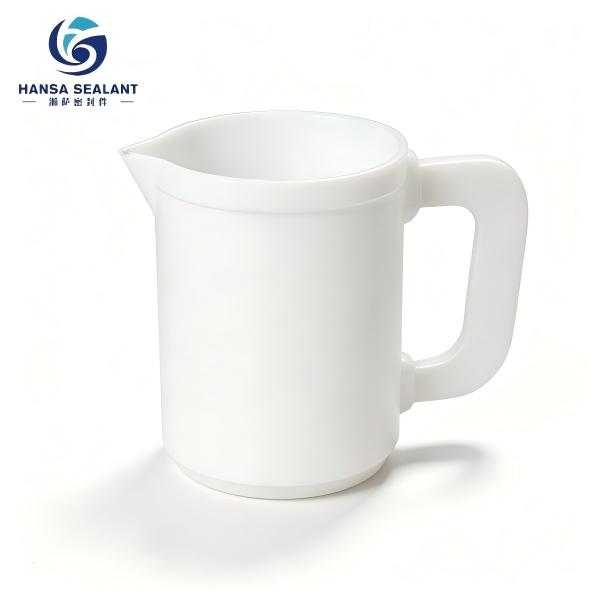
1. Product Introduction
PTFE measuring beaker, also known as PTFE beaker, is made of polytetrafluoroethylene (PTFE). It is mainly manufactured by compression molding and precision machining: PTFE powder is cold-pressed under high pressure in molds to form blanks, followed by high-temperature sintering for curing. The cup body, pouring spout and handle are integrally processed by CNC lathe without bonding seams.
Equipped with a pouring lip and ergonomic handle, this product can be used for liquid measuring, reagent holding and heating reactions. Widely applied in labs with highly corrosive media, it serves as an alternative to glass beakers to avoid glass corrosion, cracking and sample contamination.
2. Physical & Chemical Properties
Item
Performance Parameter
Remarks
Chemical Stability
Excellent corrosion resistance
Resistant to strong acids, strong alkalis, strong oxidants and organic solvents. Almost insoluble in all solvents. Only molten alkali metals and elemental fluorine can cause erosion at high temperature.
Working Temperature Range
-200℃ ~ +260℃
Suitable for cryogenic storage; long-term service below 260℃, short-time peak up to 300℃. Direct open flame burning is forbidden.
Coefficient of Friction
0.04
One of the lowest among solid materials. Inner wall reduces material adhesion and sample residue for easier cleaning.
Surface Feature
Non-stick property
Samples and precipitates hardly adhere to the cup wall, minimizing sample loss.
Insulation Property
Excellent high insulation
Applicable to electrochemistry and microwave sample pretreatment.
Mechanical Property
Soft texture, creep resistance inferior to rigid materials
Lower rigidity than glass. Avoid scratching with hard tools; prone to deformation under high pressure.
Permeability
Low permeability
Low moisture absorption and low penetration to prevent cross-contamination.
3. Typical Application Fields
Industry
Application Scenarios
Environmental Testing
Soil digestion, heavy metal sample pretreatment, wastewater sample storage, wet digestion tests
Geology & Mineral Resources
Ore acid digestion, rock sample digestion, experiments involving hydrofluoric acid (unusable for glassware)
Analytical Chemistry Labs
Trace analysis, sample preparation for ICP / AAS to prevent contamination from metal ion leaching
Semiconductor & New Energy
Pure reagent dispensing, lithium raw material testing, storage and measuring of high-purity chemicals
Pharmaceutical & Fine Chemicals
Preparation of corrosive reagents, reaction of pharmaceutical intermediates with no impurity leaching to contaminate samples
Universities & Research Institutes
Corrosion-resistance experiments for chemistry, materials research and academic teaching
4. Selection & Design Guide
Selection tips: Choose specifications based on volume, working temperature and chemical media. PTFE is mandatory for systems with hydrofluoric acid, aqua regia and concentrated strong alkalis. Dry burning must be avoided during heating. Handled versions are recommended for large-capacity models for easier operation.
Model
Volume
Cup Diameter(mm)
Cup Height(mm)
PTFE-150
150ml
63
80
PTFE-250
250ml
74
95
PTFE-500
500ml
90
115
PTFE-1000
1000ml
110
140
PTFE-2000
2000ml
140
170
Notes: Non-standard volume and thickened-wall versions are available on request. Matching PTFE lids can be supplied as optional accessories.
5. Operation & Maintenance
5.1 Operation
5.1.1 Heat sources: Oil bath, water bath and electric hot plate are acceptable. Direct open flame heating and dry burning are strictly prohibited. Operating temperature cannot exceed 260℃.
5.1.2 Handling: Pour liquids via the pouring lip. Avoid scratching the inner wall with metal tweezers or hard scrapers, which may leave scratches for impurity retention.
5.1.3 Media limitation: Not suitable for molten alkali metals and high-temperature fluorine gas, which will erode PTFE material.
5.2 Maintenance
5.2.1 Cleaning: After experiments, soak with dilute acid or solvent and clean with soft brushes. Steel wool polishing is forbidden.
5.2.2 Storage: Store horizontally or hang after full cleaning and drying. Do not apply long-term heavy compression to prevent cup deformation.
5.2.3 Replacement rule: Replace the beaker when heavy scratches, whitening, deformation or cracks appear on inner surface to avoid sample adsorption and leakage.
6. Development Trends
6.1 High-purity grade: Driven by semiconductor and trace analysis markets, high-purity PTFE measuring beakers with ultra-low metal leaching gain growing demand to reduce trace element contamination.
6.2 High-precision machining: CNC precision machining delivers tighter dimensional tolerance. Graduated versions and thickened anti-deformation styles can be customized.
6.3 Modified PTFE composites: Filled modified PTFE is adopted in certain scenarios to improve rigidity and anti-creep performance and reduce high-temperature deformation.
6.4 Lightweight & standardization: Standardization of laboratory consumables, supporting complete sets of PTFE accessories including lids and stir bars to provide integrated solutions.
6.5 Green manufacturing: Optimized sintering process cuts energy consumption and improves raw material utilization.
7. Market Application Expansion
7.1 Traditional laboratory market: Environmental monitoring stations, quality inspection institutions and university labs form the fundamental market. PTFE beakers gradually replace glass beakers for corrosive applications.
7.2 Emerging industries: Rapidly rising demand in semiconductor wet lab, lithium battery material R&D, new energy material pretreatment and advanced material research.
7.3 Pilot industrial test: Small-scale reaction in fine chemical and pharmaceutical intermediate pilot production for preparing and transferring small batches of corrosive reagents.
7.4 Overseas export business: Stable demand from overseas laboratories, mineral analysis and chemical R&D sectors, complying with international standards for chemical pretreatment.
7.5 Customization service: Accept custom orders for non-standard sizes, special thickening and unique fittings to match customized lab setups.
8. Summary & Conclusion
With outstanding resistance to strong corrosion, wide temperature range, low impurity leaching and non-stick property, PTFE measuring beakers fill the performance gap of glass and PP plastic measuring beakers in harsh corrosive and trace analysis environments. It is an irreplaceable basic labware for wet digestion, HF experiments and high-purity sample processing.
As environmental monitoring, semiconductor and new energy industries keep expanding, higher requirements on sample purity and experimental stability boost the market demand for PTFE measuring beakers. Driven by raw material purification and precision machining technology, the product will evolve toward ultra-high purity, high precision and complete accessory packages, continuously supplying reliable consumable solutions for chemical analysis and material R&D.


