
Productscpzx

1. Product Introduction & Manufacturing Method
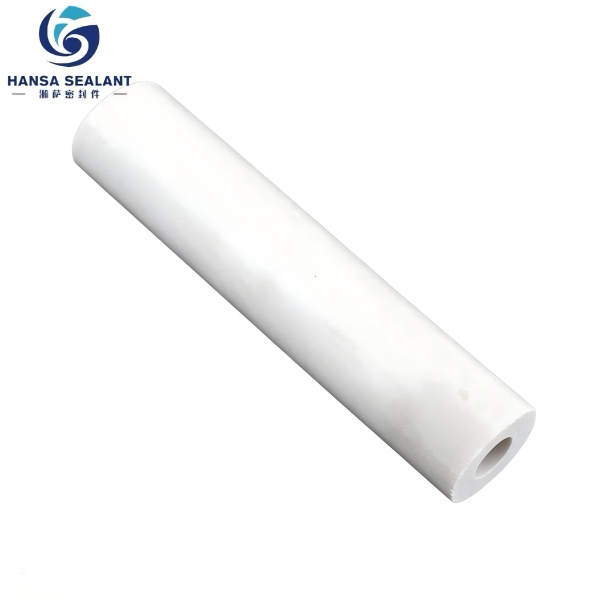
25% glass filled PTFE tube is a high-performance modified polytetrafluoroethylene composite pipe. It uses high-purity PTFE resin as matrix, incorporated with 25% by weight of alkali-free short-cut glass fiber as reinforcing filler. It is an upgraded alternative to virgin PTFE tube. This product fundamentally overcomes the inherent defects of pure PTFE such as poor creep resistance, cold flow tendency, insufficient wear resistance and deformation under high pressure, while retaining PTFE’s excellent chemical inertness, wide temperature adaptability and insulation properties. Its mechanical performance and structural stability are greatly improved, serving as a core special pipe for fluid transportation, sealing protection, insulation and wear resistance under harsh industrial working conditions.
Core Manufacturing Process: Integrated process of high-speed intensive mixing, cold forming, high-temperature sintering and precision extrusion finishing. Firstly, PTFE fine powder and 25% glass fiber are mixed uniformly in sealed chamber to avoid glass fiber agglomeration and delamination. Pipe blanks are then shaped by high-pressure cold compaction, followed by constant-temperature sintering at around 380°C for solidification to ensure tight bonding between substrate and glass fiber. Finally, precision extrusion, sizing and cutting are carried out. Wall thickness, roundness tolerance are strictly controlled throughout production, delivering dense, uniformly performing finished pipes with high dimensional accuracy suitable for precision assembly and heavy-load high-pressure working conditions.
2. Physical & Chemical Properties
| Performance Category | Parameters & Description | Working Condition Advantages |
| Temperature Resistance | Continuous service temperature: -200℃ ~ 260℃; Short-term peak temperature up to 300℃. No cracking, softening or deformation under temperature fluctuation | Suitable for alternating high-low temperature, continuous high temperature and cryogenic special conditions, covering most industrial temperature ranges |
| Corrosion Resistance | Extremely chemically inert. Resistant to most strong acids, alkalis, organic solvents, salt solutions and oil media. Not resistant to hydrofluoric acid and molten alkali metals | No aging, swelling or leakage upon long-term contact with corrosive media, preventing pipe failure caused by corrosion |
| Mechanical Properties | Tensile and compressive strength increased by over 50% vs virgin PTFE; creep resistance improved by 70%; wear resistance enhanced significantly. No cold flow or collapse under high pressure | Solves pain points of pure PTFE including easy deformation and wear, and failure under long-term compression; ideal for heavy-load & high-pressure applications |
| Insulation & Flame | Retardancy Stable dielectric performance, high insulation resistance, unaffected by temperature, humidity or frequency. Non-combustible, no toxic fumes released at high temperature | Effectively isolates current to prevent electric leakage and short circuit, meeting industrial safety flame-retardant standards |
| Friction & Self-lubrication | Ultra-low friction coefficient, smooth inner wall with self-lubrication; water absorption <0.01%, hardly scaling or medium adhesion | Low fluid transmission resistance, reduced equipment energy consumption, minimal wear under dynamic friction conditions |
| Dimensional Stability | Reinforced evenly by glass fiber, low thermal expansion coefficient, tiny dimensional deviation under high-low temperature and high pressure | Fits precision equipment assembly, reliable sealing with no loosening or leakage after long service |
3. Typical Application Fields
| Application Industry | Specific Application Scenarios | Core Function |
| Chemical Industry | Delivery pipes for corrosive acid/alkali media, equipment lining, valve sealing pipes, guide tubes for chemical reactors | Resist erosion from strong corrosive media, prevent pipe leakage and damage, ensure stable continuous chemical production and reduce equipment failure rate |
| Pharmaceutical & Medical | Purified water delivery in pharmaceutical equipment, reagent guide pipes, pipelines for medical cleaning devices, lab anti-corrosion fittings | Non-toxic, easy to clean, bacteria-free; no medium contamination, meeting high cleanliness standards for pharmaceutical and medical industries |
| Aerospace & Military | Airborne hydraulic pipelines, high-low temperature fluid sleeves, electrical insulation protection tubes, wear-resistant precision instrument fittings | Adapt to high-altitude low temperature, high pressure and complex electromagnetic interference; lightweight and highly stable to guarantee precise operation of high-end equipment |
| Electrical & Electronics | Cable insulation sleeves, high-temperature circuit protection tubes, isolation sleeves for electrical equipment, sealing fittings for high-frequency electric appliances | High insulation and flame retardancy, anti-leakage and heat resistance; protect electrical equipment and avoid short-circuit & fire hazards |
| New Energy & Environmental Protection | Electrolyte delivery tubes for lithium batteries, anti-corrosion pipes for photovoltaic equipment, guide pipes for industrial wastewater & waste gas treatment | Resist corrosive media in new energy sector and acid/alkali wastewater; fit continuous high-load production |
| Mechanical Automation | Wear-resistant pipes for hydraulic systems, oil guide tubes for automation equipment, bearing protection sleeves, sealing fittings for reciprocating motion | Reduce mechanical friction loss, improve equipment operation accuracy and stability, extend service life of automation equipment |
| Oil & Gas Industry | Valve seats of oil & gas pipelines, flange sealing fittings, delivery pipes for corrosive oilfield media | Withstand high pressure and oil/gas corrosion; applicable for Class300/600 pipeline conditions to avoid fitting failure under compression |
4. Selection & Design Guide
Standard Dimension Table
| Specification (mm) | Inner Diameter (mm) | Application Scenarios | Suitable Working Conditions |
| Φ4×1 | 2 | Precision instruments, micro electronic devices, laboratory fluid guiding | Low pressure, clean precision pipeline |
| Φ6×1 | 4 | Small automation equipment, electrical protection pipes | Normal temperature & pressure, mild friction |
| Φ8×1.5 | 5 | Pharmaceutical equipment, small chemical fluid delivery | Moderate corrosion, continuous transportation |
| Φ12×2 | 8 | General industrial automation, new energy equipment pipelines | Conventional high pressure, moderate abrasion |
| Φ16×2.5 | 11 | Chemical & environmental standard delivery pipes | Strong corrosion, continuous mass production |
| Φ20×3 | 14 | Large machinery hydraulic, oil & gas equipment pipes | Heavy load, high pressure, frequent friction |
| Φ32×4 | 24 | Large chemical equipment, industrial main pipelines | Large flow, high pressure, heavy corrosion |
| Φ50×5 | 40 | Main delivery pipelines for complete industrial sets | Extra-large flow, long-term heavy harsh service |
Selection Principles
For working conditions ≤260℃, strong corrosion, heavy high pressure and frequent friction, 25% glass filled PTFE tube is preferred. High-tolerance customized sizes available for precision assembly. Customized selection scheme can be offered for ultra high/low temperature or special media.
5. Operation & Maintenance
Installation Guidelines
Avoid scratching or hitting pipe wall with sharp objects during installation. Forbid violent bending or forced flaring to prevent invisible cracks which damage pressure resistance and sealing performance. Tighten flanges and fittings symmetrically and evenly; uneven force will cause pipe deformation and leakage. Do NOT operate continuously beyond rated temperature or pressure to prevent aging and structural failure.
Medium Compatibility
Compatible with most acids, alkalis, organic solvents, oil and aqueous solutions. Long-term contact with hydrofluoric acid, molten alkali metals and other highly corrosive media shall be avoided to prevent performance degradation and shortened service life.
Routine Maintenance
Smooth inner surface resists scaling; frequent disassembly and cleaning are unnecessary to cut maintenance cost. Regularly inspect joints, bending sections and wear-prone areas to detect hidden risks early and prevent costly equipment shutdown. Store spare pipes in dry, ventilated and shaded place. Avoid long-time sunlight exposure or humid environment to prevent material aging.
Tips for Efficiency Improvement & Loss Reduction
Standardized operation maximizes its wear resistance, low flow resistance and stability, lowering equipment energy consumption and friction loss. Reduce pipe replacement frequency to cut maintenance cost and downtime loss, improving overall equipment efficiency and reliability.
6. Industry Development Trend
Along with rapid upgrading of high-end industry, new energy, precision manufacturing and aerospace sectors, industrial pipes are developing toward high stability, high strength, long service life, light weight and customization. The industry of 25% glass filled PTFE tube presents four major trends:
6.1 Refined modification technology. Conventional general PTFE tubes are gradually replaced by modified composite pipes. The optimal 25% glass fiber formula is continuously optimized by precise mixing and homogeneous sintering to improve pipe density, fatigue resistance and dimensional accuracy for higher-end precision industrial conditions.
6.2 Accelerated domestic substitution. High-grade special pipes once relied heavily on imports. Currently domestic 25% glass filled PTFE tubes have reached international standards in performance and stability. With cost advantages, short lead time and customizability, they gradually replace imported products and become mainstream choices for domestic high-end industrial scenarios.
6.3 Green & long-life upgrade. Industries pay more attention to service life and environmental protection. Non-toxic, low-loss and reusable 25% glass filled PTFE pipe fits the trend of green low-carbon industry, replacing traditional plastic and rubber pipes with short lifespan.
6.4 Popularized customized solutions. For segmented special working conditions in new energy, semiconductors and aerospace, pipes are customized for high precision, special media resistance and wider temperature range to meet individual industrial requirements.
7. Market Application Expansion
Market demand of 25% glass filled PTFE tube keeps expanding, extending from traditional general chemical scenarios to high-end emerging industries.
• Traditional industries: It widely replaces PP, PVC and virgin PTFE pipes in chemical, machinery, environmental protection and oil & gas sectors, solving the drawbacks of conventional pipes such as poor corrosion resistance, insufficient wear resistance and easy deformation, becoming standard anti-corrosion wear-resistant industrial piping.
• High-end emerging industries: Market penetration keeps rising. In new energy, it serves for corrosive medium delivery in lithium battery, photovoltaic and energy storage equipment. In semiconductor industry, it is used for precision clean fluid guiding and insulation protection. In medical sector, it expands into high-end medical devices and biopharmaceutical sterile pipelines.
• Special military & aerospace: Thanks to wide temperature tolerance, high stability, light weight and anti-interference property, it continuously expands into aerospace, shipbuilding and precision instruments, acting as key consumables for special equipment.
Driven by industrial automation and intelligence, equipment puts higher requirements on pipe stability, accuracy and service life. The market demand of 25% glass filled PTFE tube will keep growing, with application scenarios further covering intelligent equipment, high-end manufacturing and deep-sea facilities.
8. Summary & Conclusion
25% glass filled PTFE tube is benchmark modified PTFE composite material. Adopting optimized 25% glass fiber reinforcement formula and integrated precision production technology, it perfectly combines PTFE's outstanding corrosion resistance, high-temperature resistance, insulation and low friction features with glass fiber's high strength, creep resistance and wear resistance advantages. It overcomes many limitations of virgin PTFE pipe and traditional industrial pipes with superior comprehensive performance.
Applicable for chemical, medical, aerospace, electrical, new energy, oil & gas, automation machinery and many other industries. It comes with complete specifications for easy selection, stable performance and low maintenance cost. It helps customers improve equipment stability, reduce energy consumption & loss, cut maintenance expense and extend equipment service life.
Under the trend of high-end, green and customized industrial development, 25% glass filled PTFE tube enjoys broad market prospects with excellent comprehensive performance and high cost performance. It will remain the preferred special pipe solution under harsh working conditions across industries, providing reliable guarantee for safe, stable and efficient operation of industrial equipment.


